Krishnamurti's Total Freedom
Conversations with JK

This post has been sitting in the draft folder for years. To be exact, since May 3, 2020. Every year, as the month of May approaches, I remember this draft sitting in my note folder. I need to finish that, I say to myself. But then days pass by, and I forget, and it sits there for another year.
I wonder why. Not sure. But could it be that Krishnamurti is too intellectual to grasp? I have listened to hours and hours of his lectures. It’s quite fascinating, but at the end, I wonder, “What was the takeaway?” I find it hard to conclude. I am lost in intellectuality.
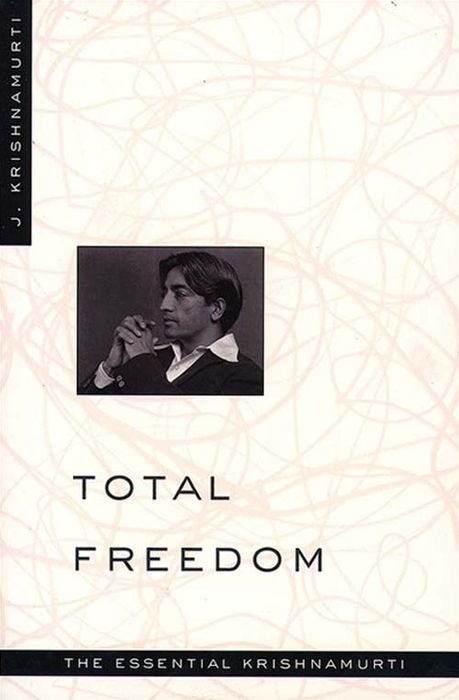
Yes, May 11 is the birthday of Krishnamurti. A good day to remember this great thinker and teacher. It was some 15 years ago, a random visit to a bookstore in Denver, when I first encountered Krishnamurti. I had pulled a shiny book titled Total Freedom from the shelf and was not able to put it down. I remember standing there, turning the pages - full of excitement. This was different than anything else I had read before.
Now, after so many years, my initial excitement is gone. I find myself not agreeing with him at times, but that is fine, I guess.
If you Google the net, you will find all about Krishnamurti. What I am trying to do here is to capture some of his thoughts that have made me think, and have a conversation - primarily - for myself.
The book starts with his bold proclamation on Truth:
“I maintain that Truth is a pathless land, and you cannot approach it by any path whatsoever, by any religion, by any sect. That is my point of view, and I adhere to that absolutely and unconditionally. Truth, being limitless, unconditioned, unapproachable by any path whatsoever, cannot be organized; nor should any organization be formed to lead or to coerce people along any particular path.”
So what is it that Krishnamurti calls Total Freedom? It is freedom from everything you have learned, freedom from your thoughts, freedom from the gurus, freedom from all organized religions. Because as long as you have these companions, you are not really free.
And I agree with him - for the most part. But it also makes me think how far this purely intellectual thought can take us. The natural next question that arises is: what do we do then? Nothing? Nothing to try? Can a human being not try to try? To achieve what they want?
I remember listening to a discourse by Ramana Maharshi. There were some follow-up questions in the end. Someone asks: “What about Krishnamurti? Krishnamurti says there is no path.” And he replies with the question: “Was it before or after he got enlightened?” Well, not exactly sure if the word was “enlightenment” - we can replace it with “freedom” or something else. But you get the idea.
So yes, for someone who has already found freedom, no path is necessary. No need to try. But for the rest of us, it’s hard work that takes us up the steps. We cannot sit idly, hoping for freedom to come on its own. At least, that’s my thinking.
And then he says:
“Religion is the frozen thought of man out of which they build temples …
… You may be educated abroad, you may be a great scientist or politician, but you always have a sneaking fear that if you don’t go to temples or do the ordinary things that you have been told to do, something evil might happen, so you conform. What happens to the mind that conforms? Investigate it, please.”
Religion - a word I am not sure what to think about. It’s a sensitive topic. Everyone you talk to belongs to one or the other religion. What does it mean by “to belong”? If we belong, we conform and so we are not free. And therefore, that which is supposed to make us free is actually a new bondage. That is what I understood.
Today, more than ever, religions of the world look more like shops than the path. These are shops that run on fear rather than love. These are multi-billion-dollar empires selling a product that does not exist.
Did the great teachers intend to create religions? I don’t know. In some way, what Krishnamurti says is true.
I do not believe in these shops either. But, at the same time, I also do not agree that there is nothing more we can do for our own freedom. And most importantly, some might ask, “Does everybody want freedom?” Maybe not. For some, living a good, simple life of service, helping others in need, is good enough. And we must agree that most religions do help people lead a good moral life.
For others who are contemplating total freedom, we must dive much deeper into the dark ocean of our minds. For such a journey, I find Buddha’s teachings to be more relevant and scientific. With his Middle Way, he rejects both Eternalism and Nihilism - Eternalism that believes in a Self and Nihilism that believes in Nothing.
Like a scientist, Buddha:
- explains the problem of human existence - with his Four Noble Truths
- then he goes on to show what you can do about it - with his Eight-Fold Path (yes, it is a Path)
- and unlike Krishnamurthi, he said - there can be only 2 mistakes: first, not to start this journey, and second, not to finish it.
- and lastly, he asked us not to put anyone else’s head above ours - not even his.
“Appo dipo bhava” - be your own light, that’s what he said.
Before I read the Buddha, I found the ideas of Krishnamurti to be new and fresh. However, now it feels that everything that is being said by some smart guru has already been said by the Buddha more than 2,600 years ago.
So, the question that arises in my mind is: why do we not give credit to someone if we know our thoughts have actually been shaped by the teachings of someone else?
In one place, he does mention:
“… and in my heart, there has been a continual thought of Lord Buddha. I was in such a state that I had to sit down and meditate …”
Now back to where we disagree …
When Krishnamurti says no path is needed, no religion needed, no guru needed - it all sounds too simple. Reality on its own is simple. But the karmic bundle that we carry from this lifetime and previous lifetimes is too complex to dismiss in a simple way. This karma is one of the most complex concepts! And a path is needed to understand and cleanse this karma!
Buddha lays out a clear path, and he treats the path as a boat. Once you cross the river, you no longer need the boat. Then, its work is done, and you don’t need to carry it with you.
That makes perfect sense to me. Once you have crossed the river, it’s all abstract and wordless. Just silence. As mentioned beautifully in The Path of Purification:
“There is the deed but no doer;
There is suffering, but no sufferer.
There is a path, but no one to enter it;
and there is liberation, but no one to attain it.”
Yes, after the freedom, there is no Buddha, no Path, no Thing.
Then, it’s pathless for sure.
A Buddhist monk was asked:
“What is Buddha?”
“Dried dung”, he answered.
That is the answer of a man who has crossed the river. Whether it’s the Buddha or the Path, for someone who has transcended, all questions and answers dissolve into silence. And therefore, “Dried dung” is as good an answer as no answer.